


September 2026 Issue
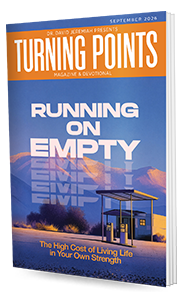
Running on Empty
From the Current Issue

Candle Light
U.S. Army Major Nicholas Nethery wrote an article entitled: “Nobody Asked Me, But... Take Care of Your Chaplains.” He described the essential role chaplains fill in our military, and he urged people to watch over their well-being. He recalled serving with a chaplain named Tom who selflessly cared for his soldiers. Their burdens became his. He gave them emotional guidance and spiritual strength. One day another officer came to Nethery and said, “Tom needs some time off.”
“What do you mean?”
the Lord can strengthen our hands so we can hold the candle steady, work in its light, and spread its glow to others.
Those of us who actively serve Christ can easily become depleted if we burn the candle at both ends. Perhaps you identify with that phrase, but what does it really mean?
The expression “burning the candle at both ends” originated from a seventeenth-century French phrase: brûler la chandelle par les deux bouts. As far as scholars can determine, it appeared in English around 1611—the same year the King James Version of the Bible was published.
Originally, the saying referred to wastefulness because candles were expensive luxuries. Burning a candle from both ends caused it to disappear twice as fast. Over time, however, the meaning evolved to describe people who exhausted themselves by working late hours. American poet Edna St. Vincent Millay helped popularize this meaning in her famous poem:
“My candle burns at both ends;
It will not last the night.”
When I think of that phrase, I don’t think of a candle that has a wick at both ends. I think of someone who gets up before daylight to work by candlelight and who stays up late working into the night, again by candlelight. Such people are burning the candle at both ends of the day, and in so doing they are burning out as fast as their candles are!
Are there time wasters in my daily routine?
In chapter 4, their enemies learned what was happening, and the threat level rose. Now, in addition to rebuilding a wall, the workers had to organize a militia and protect themselves. They worked with a trowel in one hand and a sword in another.
In chapter 5, a controversial issue arose among the residents, causing more stress. By chapter 6, the enemies believed the hands of the Jewish workers had become weakened and work could not be finished.
Without the promises of Scripture we grow frantic.
The Lord did strengthen their hands, and the work was finished. Even now in Jerusalem, guides will show you a portion of Nehemiah’s wall. I know from experience how the Lord can strengthen our hands so we can hold the candle steady, work in its light, and spread its glow to others. Weariness, then, is a God-given opportunity to reevaluate what we’re doing.
Let’s take that opportunity now.
Reduce—Learning to Prune
First, if you’re burning the candle at both ends, ask yourself: What am I doing that I should stop? Am I doing something someone else could do? Is there an activity I can delete from my calendar without catastrophic results? Are there time wasters in my daily routine?
Suppose I were to sit down with you and ask this question: Can you think of a single thing you are repeatedly doing during the course of a week that is causing you more stress than it’s worth? Maybe a regular meeting you can miss. Or it could be binge watching programs or getting caught in a cycle of web scrolling.
One of the best inventions of my lifetime is the delete button.
Rest—Leaning on Christ
We also have to learn Jesus does not expect us to work around the clock. It does not all depend on us. Sometimes we are frantically trying to do for Christ what He gently wants to do through us. The branch doesn’t have to groan and strain to bear fruit. It simply has to abide in the Vine, and the real results happen in God-produced ways.
I think this is what Jesus was getting at when He said, “Come to Me, all you who labor and are heavy laden, and I will give you rest. Take My yoke upon you and learn from Me, for I am gentle and lowly in heart, and you will find rest for your souls. For My yoke is easy and My burden is light” (Matthew 11:28-30).
Rely—Trusting God’s Word
For the energy to be productive, we also need to stay fueled up. We will more slowly burn the candle at both ends if some of our time is spent reading the Bible in its light. Without the promises of Scripture we grow frantic. Without fellowship with the Lord in His Word we grow weary.
This is especially true for caregivers, those who taking care of a disabled child or adult. One particular woman nearly came to the end of her rope while trying to care for her mother who was suffering from Alzheimer’s. Only someone who has been through this can understand the mood swings, the lost fellowship, the bathroom issues, and the emotional outbursts. This woman stayed in the Scripture and considered God to be her caregiver while she was giving care to her mother.
She especially leaned on Philippians 4:6 and its encouragement to be “anxious for nothing.” Somehow just repeating those words over and over provided moments of real strength under real stress. No one can ever explain the power contained in a simple verse of Scripture that is given to us from God.
Rebuild—Restoring Wise Boundaries
As we come in and out of stressful seasons, we can take stock of our lives, our priorities, and our calendars. A good time to do this may be when you have a day off or when you go to the beach or to the mountains for a vacation. You might consider taking your journal. Think about what is going well in your life and make a list of things that are going badly. Make a list of the stresses you feel. Prayerfully think about where you are at this very moment in the course of your life. Figure out the things you need to change. The habits you need to start. The boundaries you need to establish.
You probably cannot implement too many changes at once, and it’s always wise to start with small steps. In recent years an entire science has developed around the idea of changing or implementing habits. Experts suggest making small changes that will fit into the normal routine of our lives.
Let’s say, for example, you decide it would be beneficial to kneel by your bed at the end of the day and say the Lord’s Prayer. Your thoughts have been too scattered in the evenings, and you have taken your worries to bed with you. How would you begin this new habit? It seems simple until you try to do it.
Figure out a simple strategy that works for you. You can find cards, plaques, and engravings of the Lord’s prayer in many different places. What if you had one you kept on your pillow? What if it was there for you to see every night when you turned down your sheet? For the first week, just stand by your bed and whisper the words, “Our Father.” That’s all. Don’t kneel, and don’t say the entire prayer. Just begin with an awareness of the power of the words, “Our Father.”
The next week add the next phrase, and over time I believe you’ll find yourself kneeling every evening by your bedside and ending your day with the sincere offering of the Lord's Prayer.
Rejoice—Rediscovering the Joy of Service
If this process becomes a regular cycle in your life—reducing, resting, relying, and rebuilding—you will become a more productive person, serving the Lord with increasing joy. The outcome of that way of life is spectacular. Instead of burning the candle at both ends, you will shine the light of God’s grace into the world.
If your light burns out, you cannot shine it into the darkness. So don’t burn the candle at both ends. Instead, let your life be a candle that lights the way for others.
1 Nicholas Nethery, “Nobody Asked Me, But…Take Care of Your Chaplains,” Proceedings, U.S. Naval Institute, November 2018.
This article was first published in Turning Points Magazine & Devotional. Learn more about the magazine and request your free issues today!

This Month's Magazine Resource

The Light of the World 2027 Calendar
Each month features a different region where the Gospel is reaching people. As you turn each page, you'll learn about the people, the language, and the need—and know that your partnership helps shine the light there.
Subscribe Now
Each month, read articles and devotionals from Dr. David Jeremiah that will encourage, challenge, and strengthen your walk with the Lord.




 Turning Point for God is a tax-exempt, not-for-profit, religious corporation as defined under Section 501(c)(3) of the Internal Revenue Code. Your donation gift(s) are very much appreciated and may qualify as a charitable deduction for federal income tax purposes.